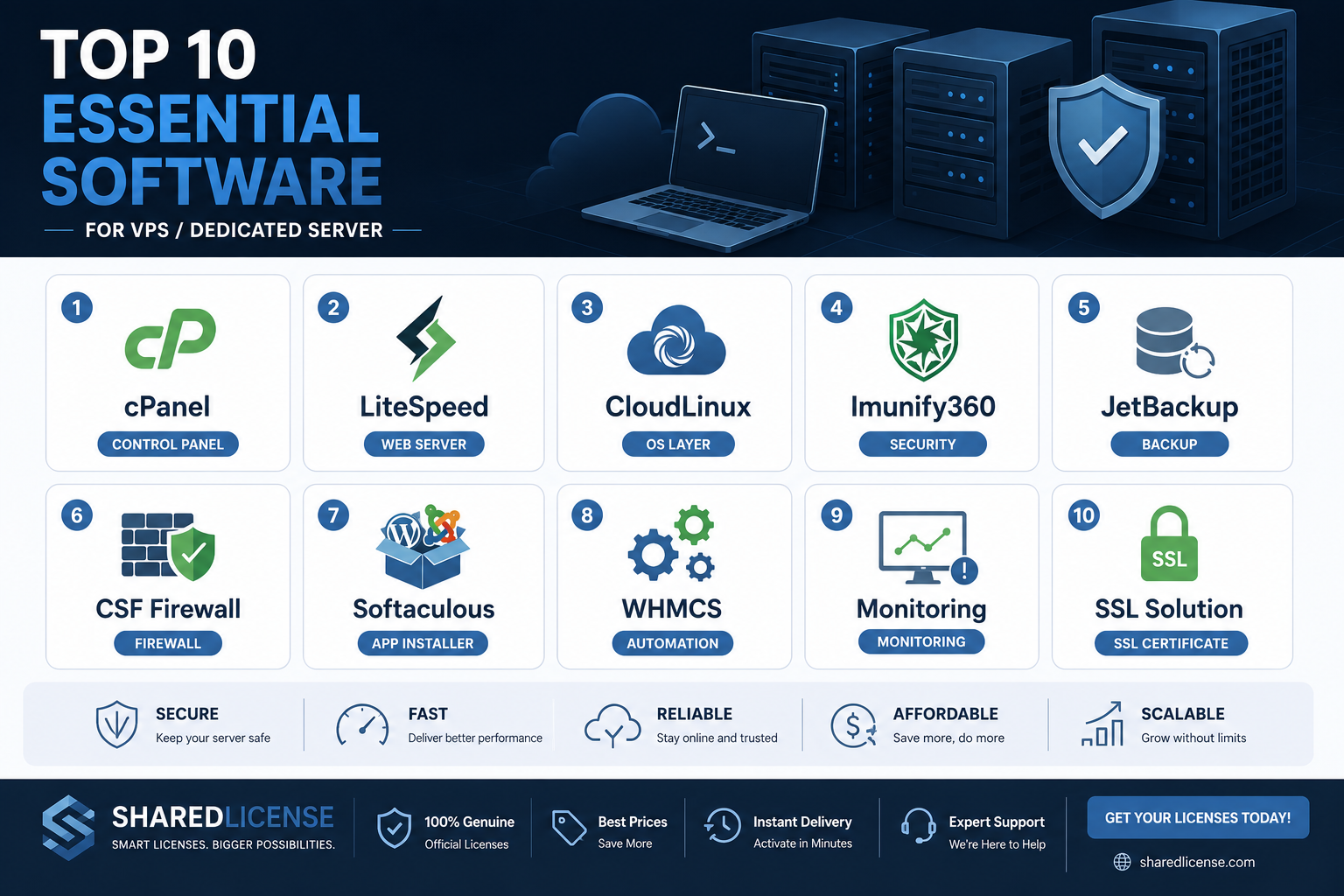
A Fresh Server Is a Blank Canvas — Here Is What to Install First
When you get a new VPS or dedicated server, it usually arrives almost empty. Just an operating system and a blinking command line. From there, it is up to you to turn it into a machine that can host websites, fight off hackers, back up data, and recover quickly when something goes wrong. The software you choose to install is what separates a shaky, slow server from a fast, secure, reliable one.
Quick summary
Looking for affordable server licenses? SharedLicense offers cPanel, DirectAdmin, LiteSpeed, CloudLinux, and Windows licenses at wholesale prices with instant delivery.
Browse licenses →
Whether you are setting up your first server or your fiftieth, there is a short list of tools that every serious server should have. These are the workhorses of the hosting world — battle-tested software that providers rely on every single day. Skipping any of them usually means more downtime, more support tickets, and more headaches down the road.
This guide covers the top 10 essential software tools for a VPS or dedicated server in 2026, and explains in simple terms why each one matters.
1. The Core: Control Panel, Web Server, and OS Layer
These first tools form the foundation of your server. Everything else builds on top of them.
1. cPanel (or DirectAdmin) — Your Control Panel. A control panel is the dashboard you use to manage websites, email, DNS, and files without typing commands all day. cPanel is the industry standard, loved for its familiar interface and huge ecosystem. DirectAdmin is the budget-friendly alternative with flat pricing and lower resource use. Either way, a control panel turns a raw server into something you (and your customers) can actually use.
2. LiteSpeed — Your Web Server. The web server is what delivers your pages to visitors. LiteSpeed is the top choice for speed and efficiency. It uses far less memory than Apache, handles traffic spikes with ease, and its built-in caching makes WordPress sites load in a flash. If you want fast sites and happy customers, LiteSpeed is one of the best upgrades you can make.
3. CloudLinux — Your OS Layer for Shared Hosting. If more than one customer lives on your server, CloudLinux is essential. It isolates each account with its own resource limits and a secure cage, so one bad site cannot slow down or threaten the others. It also lets each account pick its own PHP version, which prevents a flood of “my site broke” tickets. For shared hosting, CloudLinux is the difference between chaos and calm.
2. Security and Backups: Protect Your Data and Your Sleep
A fast server that loses its data or gets hacked is worthless. This second group of tools keeps your server safe and makes sure you can always recover.
4. Imunify360 — Your Security Shield. Imunify360 is an all-in-one security suite built for hosting servers. It combines a firewall, intrusion detection, malware scanning, and proactive defense against attacks. It blocks brute-force login attempts, quarantines infected files, and stops known malware before it spreads. For shared hosting, where you cannot control what customers upload, Imunify360 is one of the smartest investments you can make.
5. JetBackup — Your Backup Lifeline. Backups are the one thing you never skip. JetBackup is the modern favorite because it uses incremental backups — it only copies what has changed, which saves huge amounts of storage and time. It can send backups to cheap cloud storage and restore a single file or an entire account in a few clicks. When disaster strikes (and eventually it will), JetBackup is what saves your business.
6. ConfigServer Firewall (CSF) — Your Server Guard. CSF is a free, powerful firewall that locks down your server’s network. It blocks suspicious IP addresses, limits login attempts, and gives you a clear view of what is connecting to your machine. While cPanel servers often include CSF by default, it is worth checking on any server to make sure your ports are protected.


